
Preparing for OSHA HazCom updates: What you actually need to do before May 19, 2026
Series: The Complete OSHA Hazard Communication Guide — Part 1 of 6
When OSHA updates something as foundational as the Hazard Communication Standard (HCS), most organizations have the same reaction:
They skim the summary, note the deadline, and think: we’ll deal with this later.
But HazCom updates don’t usually work that way. They ripple across safety data sheets (SDSs), labeling, training, and audits. Compliance deadlines are spread over months and even years. And if all those pieces aren’t aligned, gaps start to form.
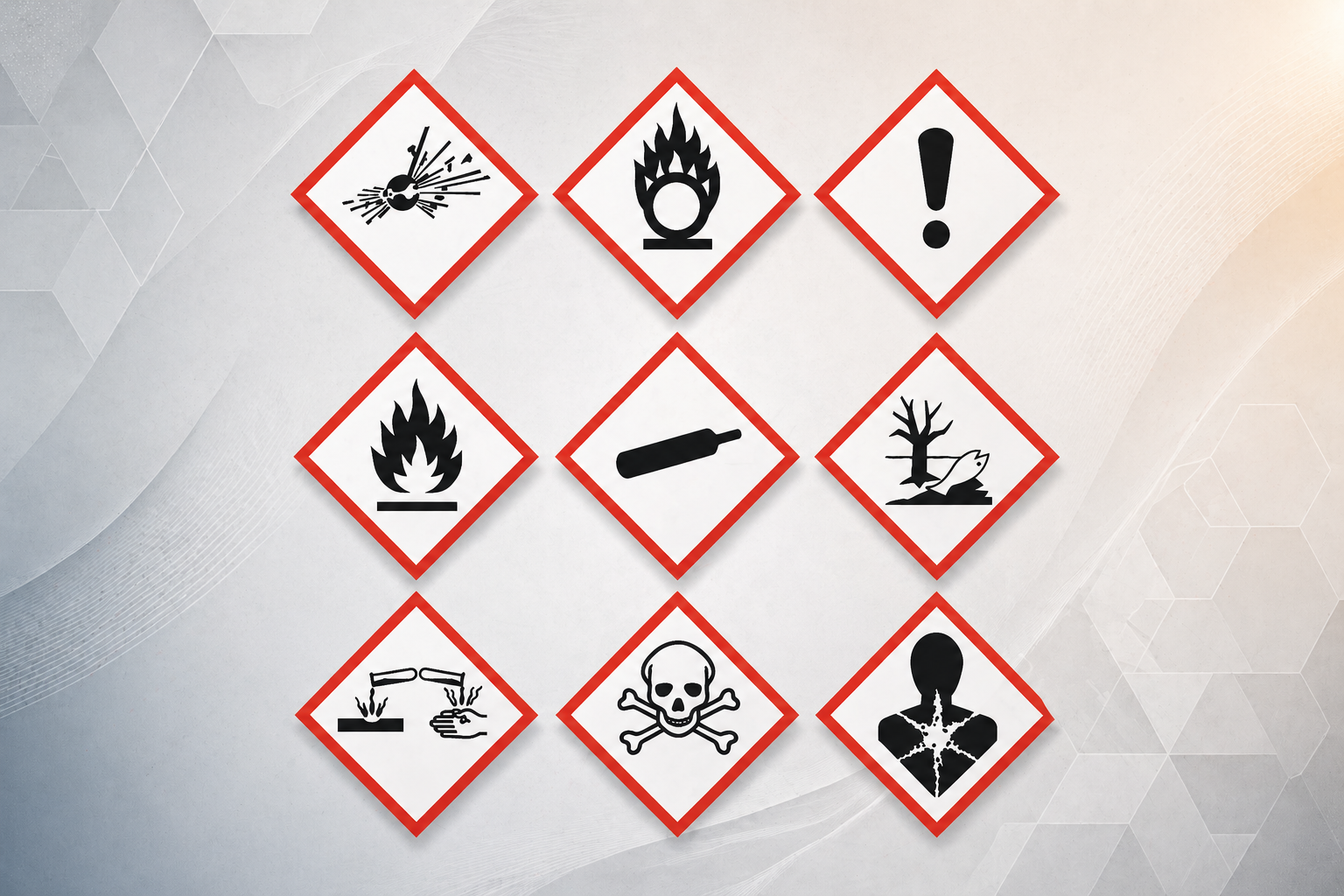
OSHA’s recent revision of the Hazard Communication Standard, 29 CFR 1910.1200 (HCS), aligns hazardous chemical labeling requirements with the United Nations’ Globally Harmonized System of Classification and Labelling of Chemicals (GHS). Pictured are pictograms used on labels of hazardous chemicals.
Why this update is more complex than it looks
This latest update, aligning OSHA with GHS Revision 7, has its first key date fast approaching: May 19, 2026. By that date, chemical manufacturers, importers, and distributors evaluating substances must update labels and Safety Data Sheets (SDSs) to meet the revised standard.
That sounds straightforward until you look at how interconnected these elements are. Updating an SDS without aligning labels—or retraining employees—creates inconsistencies that are hard to track and even harder to defend during an audit.
Need more context on the rule changes? OSHA’s HazCom page is a good place to start: https://www.osha.gov/hazcom
But most teams aren’t struggling to find the rule. They’re struggling to apply it consistently within a broader HazCom compliance program.
Where most companies get stuck
What we see most often is not a lack of effort, but a lack of coordination.
SDS updates may be managed by one department. Another team manages updating the labels. A different crew manages the training. Audits often become a last-minute check to confirm everything is in place.
That approach works… until it doesn’t. And when it breaks down, it’s usually during an audit or inspection.
Turning compliance into a repeatable process
The organizations that handle these updates will treat compliance as a process, not a project.
They build a way to verify, document, and revisit what’s been updated, before anyone asks for proof. Tools like GapCross support that by bringing structure to how updates are tracked, verified, and recorded.
Next: We’ll look at how to turn that idea into something practical: a repeatable HazCom audit process.
OSHA Hazard Communication Series
Part 1: Preparing for OSHA HazCom updates (Current)
Part 2: Why most HazCom audits fail
Part 4: Why HazCom breaks down