
AI can increase capacity without replacing human expertise
Most organizations do not have a shortage of worthwhile work.
There are employees to orient and train, procedures to follow, information to collect, assessments and inspections to perform, problems to investigate, and improvements to make.
The constraint is often time and experienced people.
This is one of the reasons I believe the discussion about whether AI will eliminate jobs misses many opportunities.
AI can help people accomplish more of the work that already needs to be done.
AI provides exploration; operational systems provide consistency
AI is particularly good at exploration. It can work across enormous amounts of information, identify relationships, explain concepts, develop alternatives, and help people work through unfamiliar problems.
That flexibility is valuable. But ask the same question slightly differently, provide different context, or use a different source base, and the response may change.
There are many activities where that flexibility is exactly what we do not want.
When performing an inspection, following a critical procedure, collecting required information, or completing a regulatory assessment, the organization usually wants people to work from approved information and follow an established process.
That is where controlled operational applications become important.
A GapCross application can guide a new employee through orientation, support a training program, walk someone through a procedure, collect required data, or guide an assessor or inspector through a defined set of requirements.
The objective is methodical execution.
The application establishes the approved process and information. People follow it consistently, required information is captured, and there is a record of who did what and when.
That doesn't mean people blindly follow software.
Real work doesn't always follow the expected path. Conditions change. Exceptions occur. Experienced people recognize situations that weren't anticipated when a procedure was written.
People need to be able to exercise judgment and, when appropriate, deviate from the established process. The important distinction is that deviations should be controlled and documented so the organization can understand what happened and learn from it.
AI should support human expertise, not replace it
Consider new employee orientation.
An operational application can guide a new employee through required information and activities at their own pace. It can make sure important topics aren't overlooked and create a record of what has been completed.
But it shouldn't replace the manager, mentor, or coworkers who welcome the employee, answer questions, explain the culture, and begin building relationships.
The technology handles more of the routine structure so people have more time for the parts that require people.
The same principle applies to AI.
AI doesn't need to replace the subject matter expert. It can perform much of the tedious analysis and preparation so the expert can spend more time applying judgment, solving problems, and improving the organization.
That is how technology increases organizational capacity.
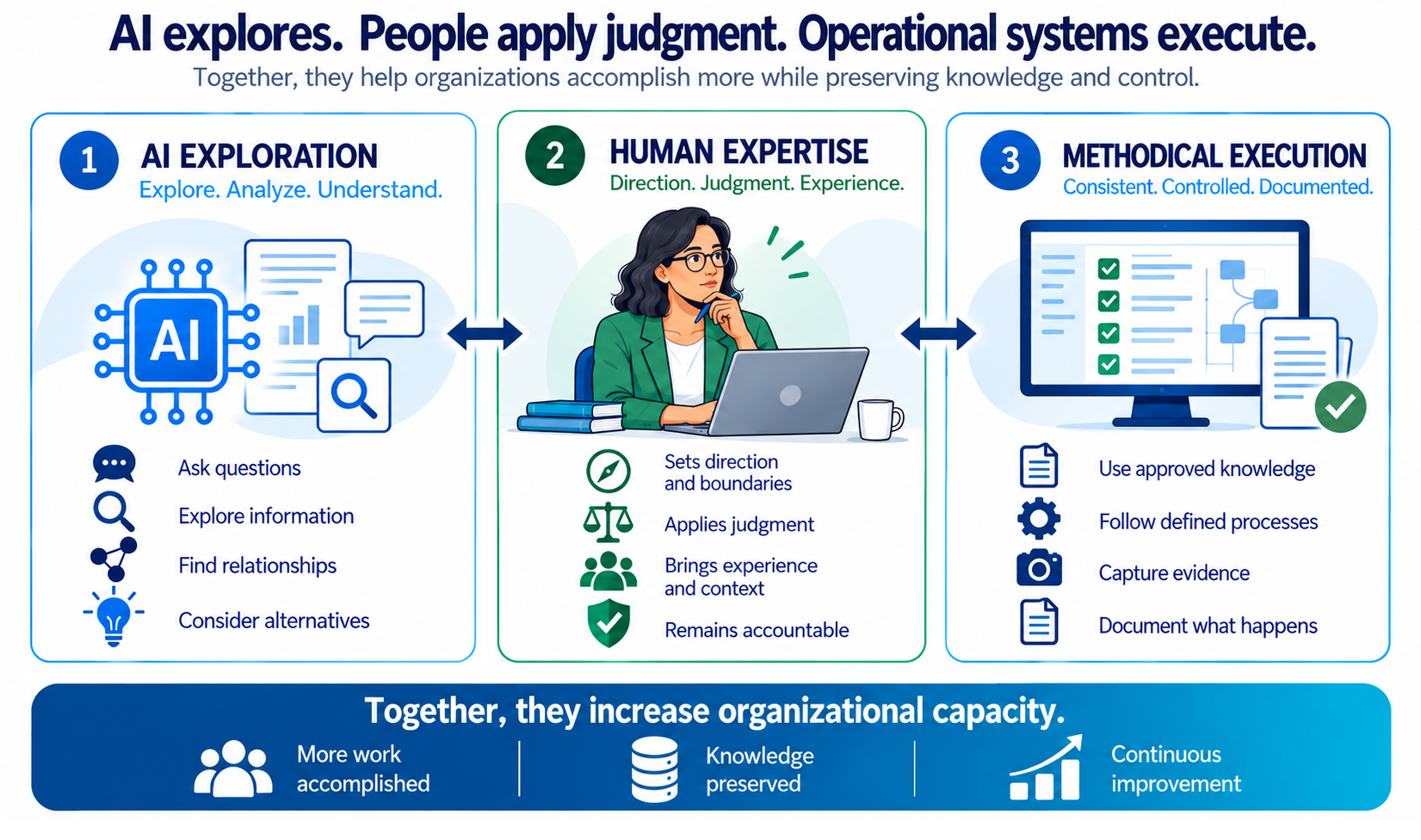
Combining AI exploration with methodical execution
I see an important opportunity in bringing these two approaches together.
AI provides exploration.
Ask questions. Examine alternatives. Find relationships. Help people understand unfamiliar situations.
Operational applications provide methodical execution.
Use approved knowledge. Follow established processes. Collect required information. Document actions. Maintain consistency.
There are times when someone following a controlled process will need additional knowledge or assistance. That is where AI exploration can become valuable within the context of the work being performed.
But the controlled process remains the foundation. And what happens should still be captured.
Who performed the activity?
What did they do?
When did they do it?
What information did they rely upon?
Did they follow the established process?
If they deviated, why?
What can we learn from the outcome?
AI can help turn experience into institutional knowledge
Those records turn today's work into tomorrow's institutional knowledge.
The result is a cycle:
Knowledge → Application → Execution → Experience → Improvement → Application
AI can help throughout that cycle, but it doesn't replace the cycle.
The larger opportunity is not using AI to eliminate people or using software to eliminate human judgment.
It is combining human expertise, AI assistance, and methodical digital execution so organizations can accomplish more with the people they have, preserve what they learn, and continuously improve how work gets done.
That is how we Transform Knowledge into Action.
