
From standards to assessments: Using AI without losing expert judgment
In the last Insight, I discussed how AI can help subject matter experts apply more of what they know.
A good example of this is how AI can assist in developing an assessment from a technical standard.
On the surface, creating an assessment from a standard might sound straightforward. Read the standard, identify the requirements, and turn them into questions.
In practice, it is rarely that simple.
A standard may reference requirements contained in a federal regulation. An organization may already have an established checklist based on years of experience. Definitions in one source may affect how requirements in another should be interpreted.
The assessment needs to bring those sources together without losing their meaning.
Traditionally, that requires considerable manual effort.
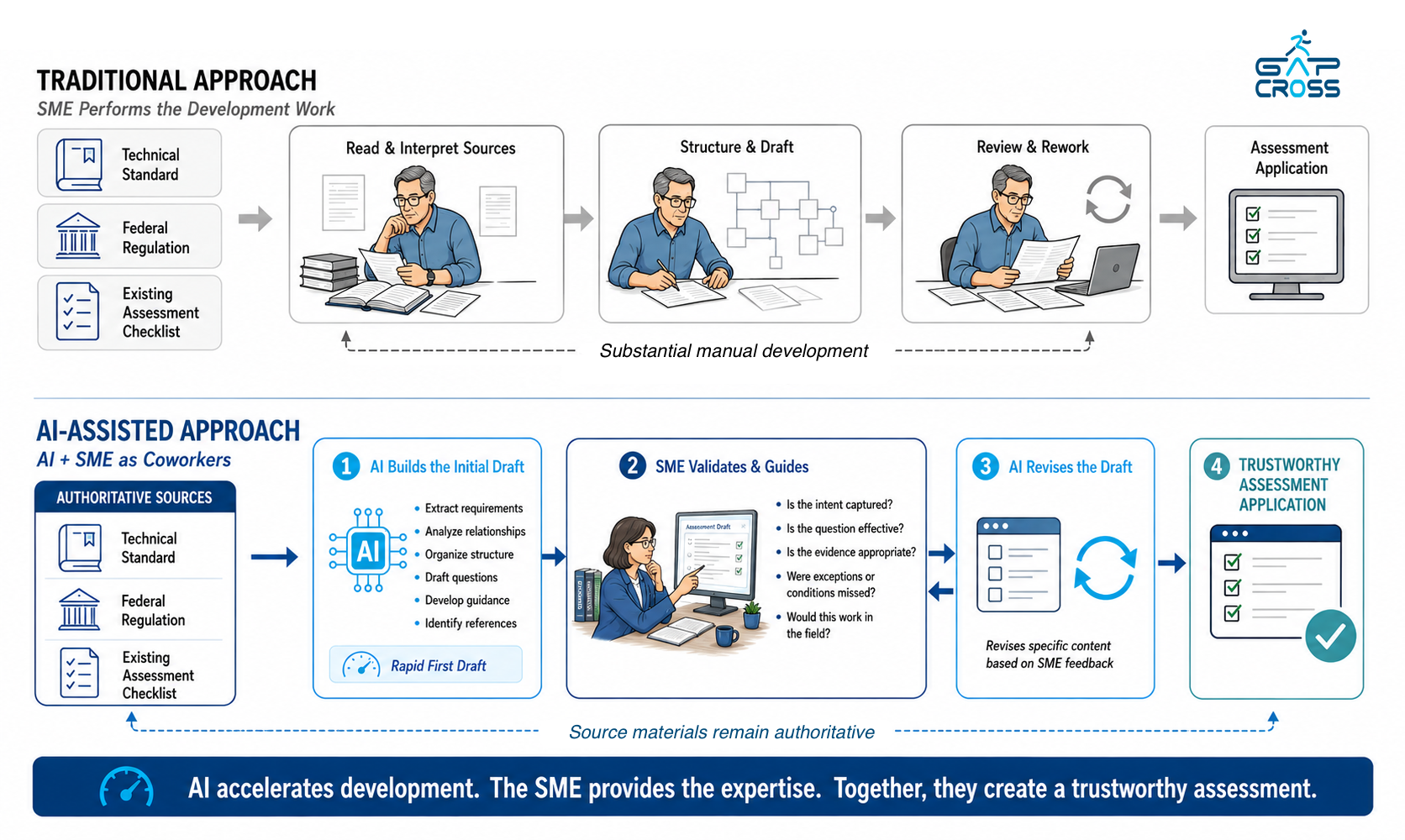
Someone has to read the source documents, identify applicable requirements, determine relationships between them, organize the requirements into a logical structure, develop assessment questions, add guidance, identify appropriate evidence, establish references, and determine how the results should be documented.
Finally, the subject matter expert has to review it.
That last step is important because converting authoritative content into an assessment requires more than simply extracting requirements.
Starting with intelligent assistance
We recently explored what happens when intelligent tools are given three sources:
A technical standard + a referenced federal regulation + an existing assessment checklist
With source materials providing the foundation, AI can stay grounded in those materials rather than relying on its general knowledge.
The tools can analyze the content, identify relationships between the sources, organize requirements, and develop a surprisingly sophisticated first draft of an assessment application.
Questions can be drafted.
Guidance can be developed.
References can be identified.
Related requirements from different sources can be brought together.
A structure that previously required substantial manual development can begin taking shape very quickly.
But that is where an important distinction needs to be made.
Producing a feasible draft is fast. Developing a trustworthy assessment still requires expertise.
The subject matter expert changes roles
The subject matter expert no longer has to begin with a blank page.
Instead, the SME begins with something to challenge.
Is this really what the requirement means?
Does the question determine whether the intent of the requirement is being met?
What evidence would demonstrate conformity?
Would an assessor understand what to look for?
Did the AI correctly interpret the relationship between the standard and the regulation?
Did it overlook an exception, definition, or condition that changes the requirement?
Would this question actually work during an assessment?
Those are not simply editing questions. They require knowledge of the subject.
The SME reviews the draft, corrects interpretations, improves questions, adds practical guidance, and incorporates the experience that may never have appeared in the source documents.
That is where institutional knowledge enters the application.
From technical standard to operational assessment
The objective is not simply to create a better checklist.
A digital assessment can guide the assessor through the requirements, provide guidance when it is needed, capture evidence where it belongs, document observations, trigger follow-up activities, and create a consistent record of the assessment.
The source documents remain authoritative.
The application becomes the operational tool through which those requirements are consistently applied.
That distinction matters.
A standard tells us what is expected. A regulation establishes legal requirements.
An existing checklist may capture years of practical experience. The SME understands how those pieces fit together.
AI can dramatically accelerate the work required to bring them together.
And the digital application puts that combined knowledge into the hands of the person performing the assessment.
Faster does not mean automatic
This may be one of the most important lessons as quality professionals begin applying AI.
The goal should not be to see how quickly AI can generate an assessment.
The goal should be to see how much routine development work can be accelerated while maintaining the technical judgment, source integrity, and oversight required to produce a trustworthy result.
That requires understanding what AI should be allowed to do, what it should not be trusted to do on its own, and what the subject matter expert needs to know to oversee the process effectively.
At GapCross, that is the opportunity we are exploring: how intelligent tools can help turn expertise into practical, trustworthy applications without losing the judgment behind them.
