
AI changes how we put expertise to work
Organizations already possess enormous amounts of knowledge.
It exists in standards, regulations, policies, procedures, checklists, training materials, and in the experience of the staff. The challenge has always been turning that knowledge into something people can consistently use while doing their jobs.
Traditionally, transforming this content into a digital assessment, procedure, inspection, or other operational application has required considerable time and expertise.
Someone has to read and interpret the source material, identify requirements and decision points, organize the content, develop questions or instructions, provide guidance, establish references, and determine what information needs to be collected.
Then someone who understands the subject has to make sure it is right.
That last part hasn't changed.
AI accelerates preparation, not judgment
What has changed is how much of the work leading up to it can now be assisted by AI.
Given the right source material and direction, AI can help identify requirements, organize information, compare multiple sources, draft assessment questions, develop instructions and guidance, and create the foundation for an operational application.
Work that once required starting with a blank page can begin with a surprisingly sophisticated first draft.
But a sophisticated draft is still a draft.
A standard may say what is required without explaining the best way to determine conformity. A regulation may contain definitions or requirements that affect provisions found elsewhere. A procedure may make perfect sense to the person who wrote it while leaving important assumptions unstated.
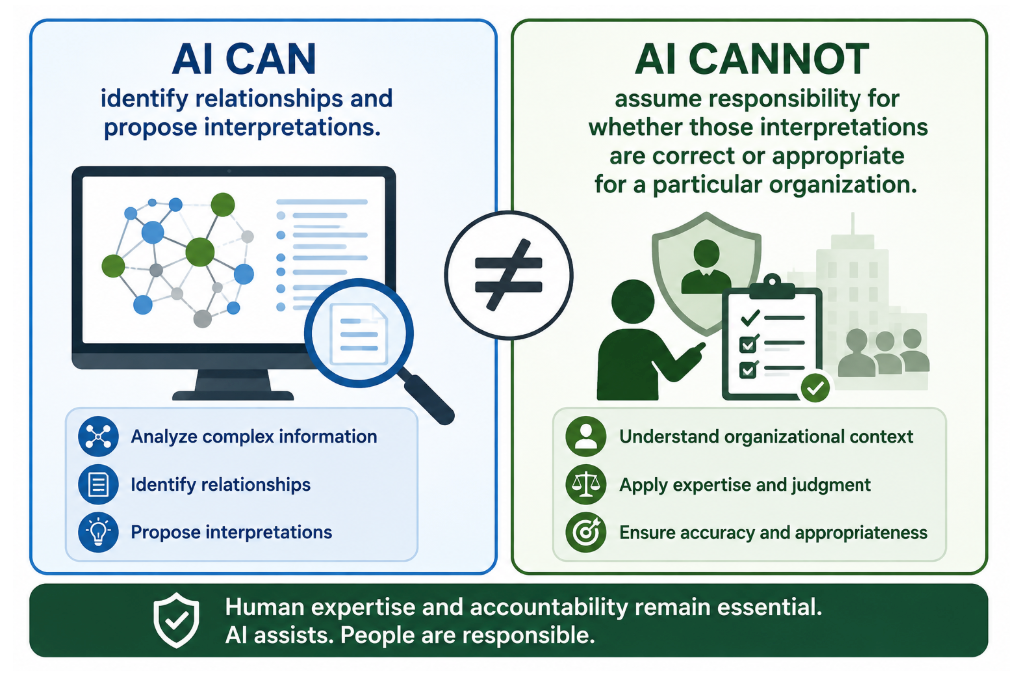
AI can identify relationships and propose interpretations. It cannot assume responsibility for whether those interpretations are correct or appropriate for a particular organization.
Why subject matter experts matter even more
The role of the subject matter expert is more relevant than ever.
The SME understands the intent behind the requirements. The SME recognizes when technically correct wording could be misleading in practice. The SME knows what evidence is meaningful, what questions need to be asked, what people performing the work need to know, and where experience has taught them to look more closely.
Expanding what experts can accomplish
Most quality organizations do not have a shortage of work.
Self-assessments need to be performed. Processes need to be reviewed and improved. Procedures need to be updated. Problems need to be investigated. New requirements and initiatives need to be addressed. Yet there is rarely enough time or enough experienced people to do everything that could improve the organization.
The opportunity for AI is not simply to eliminate jobs. It is to expand what the people already there can accomplish.
When routine development work that once consumed days or weeks can be completed much faster, subject matter experts have more time to apply their knowledge where it matters. And as quality improves and fewer resources are consumed dealing with recurring problems, organizations gain the capacity to pursue initiatives that previously had to wait.
That doesn't necessarily mean fewer quality professionals. It may mean organizations can finally accomplish more of the quality work they already know needs to be done.
This changes the division of labor.
Instead of spending much of their time extracting information, organizing content, and creating first drafts, subject matter experts can spend more of their time reviewing, questioning, refining, and applying their expertise.
AI does more of the preparation. The expert spends more time applying expertise.
Putting knowledge to work
The result can be much more than a faster way to create documents.
Standards can become guided assessments. Procedures can become executable workflows. Regulations can be incorporated directly into compliance activities. Existing checklists can become applications that collect evidence, guide decisions, document actions, and provide a consistent record of who did what and when.
The opportunity is not to replace expertise with AI.
It is to use AI to make expertise easier to capture, apply, and preserve.
And when smart applications are used in everyday work, experience creates new knowledge that can be fed back into the application, continuously improving how the organization operates.
That is where AI and operational platforms like GapCross become particularly interesting for quality professionals.
AI can help transform existing knowledge into operational applications. GapCross puts that knowledge to work through assessments, procedures, and other workflows where it can be applied, refined, and preserved.
Not because AI knows more than the experts. But because, when used correctly, AI and digital tools can help experts put more of what they know to work.
