
Series: Words Matter
How language shapes quality management, audits, and standards

Previously, I discussed how confusing hazards with risk can lead to poor decisions. The lesson wasn't really about hazards or risk. It was about how the words we use influence the way we think, implement requirements, and evaluate conformance.
While leading the development of the upcoming ASTM D8675-26, Standard Guide for Continuous Improvement for Cannabis and Hemp Operations, a ballot comment prompted another interesting discussion.
The feedback was that the guide should address continual improvement as well as continuous improvement.
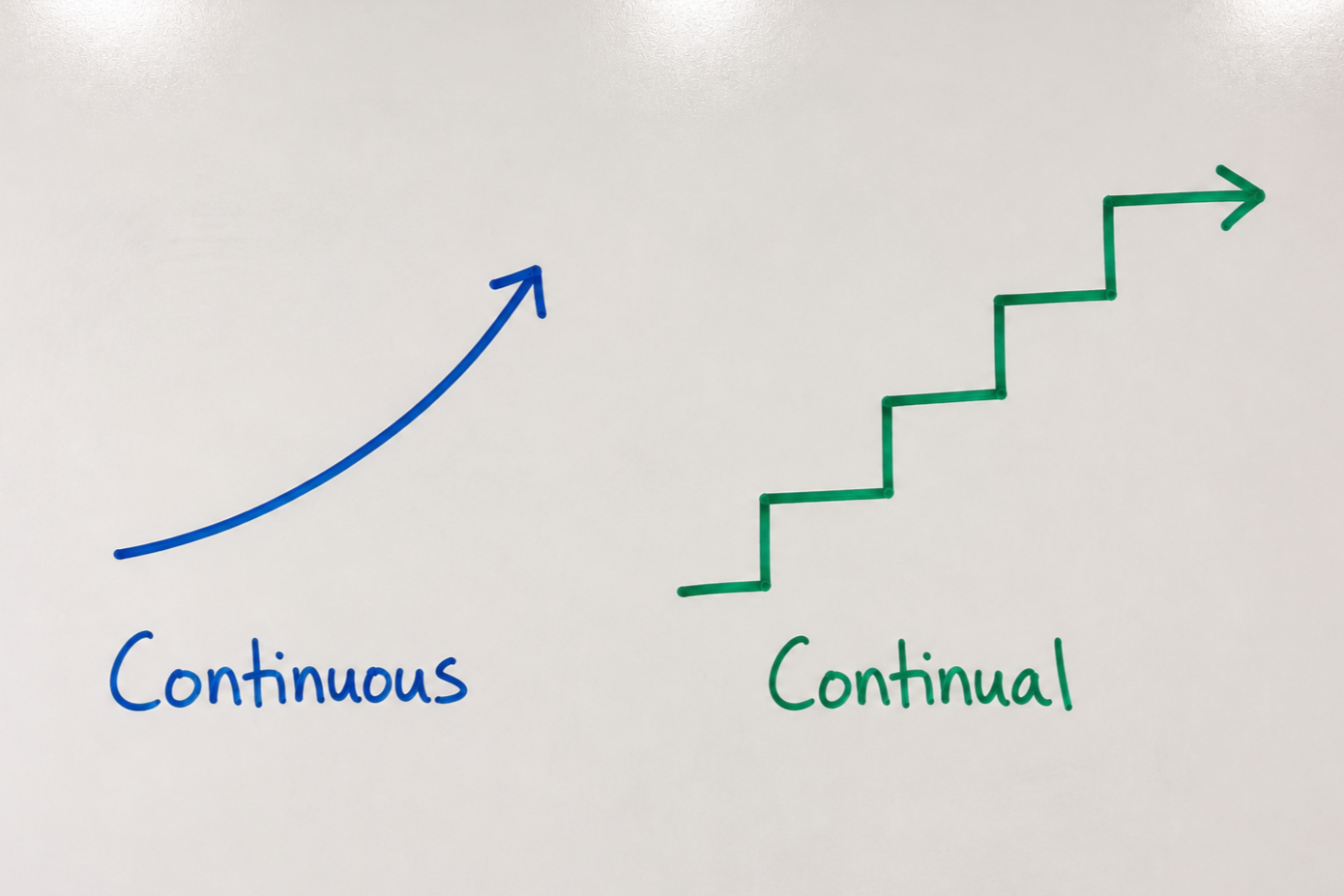
Continuous improvement involves ongoing, day-to-day process adjustments, while continual improvement advances through planned changes made during structured review cycles.
Continuous vs. continual improvement
Having promoted continuous improvement as a workplace culture for more than three decades, I had generally viewed the terms as interchangeable. The ballot comment led to a thoughtful discussion with Cary Black of CK Black Group, who pointed out that many quality professionals see an important distinction:
Continuous improvement is the ongoing rhythm of day-to-day improvement.
Employees identify opportunities, report problems, suggest ideas, and make small incremental improvements as work is performed. The organization continuously learns from experience and gradually improves its processes.
Continual improvement operates in systematic increments.
Management periodically steps back to review trends in complaints, corrective actions, audit findings, customer feedback, strategic objectives, and organizational performance. Those reviews often lead to larger initiatives that require planning, resources, and time to implement, and to stabilize before the next major improvement effort begins.
One resembles a steady upward path built from many small adjustments.
The other resembles climbing a staircase, where each step represents a significant improvement, followed by time to evaluate the results before moving to the next level.
Whether every quality professional agrees with this distinction is, in many ways, beside the point.
Why the distinction matters
What interests me is the effect different interpretations can have.
If one organization views improvement primarily as employee-driven incremental change, while another views it as periodic management initiatives, both may sincerely believe they are meeting the same requirement.
Would an auditor evaluate them the same way?
Perhaps.
Perhaps not.
As I have written in previous articles, shared understanding takes time. Consistent implementation depends on that shared understanding. The greatest value in discussions like this is not necessarily deciding which definition is correct. It’s ensuring that organizations, auditors, consultants, and standards developers are working from the same understanding when they apply the requirement.
Over the years, I have found that organizations rarely struggle because they lack a desire to improve. More often, they struggle because people share different mental models of what effective improvement looks like.
When that happens, two experienced professionals can evaluate the same organization and reach different conclusions, even though both are acting in good faith.
Lessons for designing better assessment programs
This discussion also highlights an important principle in assessment design: Assessment questions should reduce unnecessary ambiguity without prescribing a single implementation. If assessors consistently interpret a requirement differently, the assessment itself may need refinement.
Small improvements to questions, guidance, examples, tips, or references should be made continuously as auditors and subject-matter experts gain experience. Those refinements help each new assessor begin with a clearer understanding than the one before.
Larger updates are different. New editions of standards, regulatory changes, changing customer expectations, or significant organizational changes often require more substantial revisions to an assessment program. Those changes occur less frequently, but they are equally important.
In many ways, assessment programs benefit from both forms of improvement.
They improve continuously through the steady accumulation of experience.
They continually improve through periodic updates driven by evolving requirements.
Either way, the result is an assessment program that not only evaluates continual improvement within an organization but also demonstrates continuous improvement in how it evolves over time.
Perhaps the terminology itself contributes to the confusion. Personally, I think strategic improvement would communicate the concept more clearly than continual improvement, but I'd be interested in hearing how others view these terms.
I’d love to hear your stories and examples of positive continuous vs continual improvements in your processes.
About the author
Ed Nodland has more than 30 years of experience in quality systems, auditing, standards development, software development, and risk management. He is the founder of GapCross.
