Digital transformation of institutional knowledge
The term body of knowledge is well known to quality professionals, but every organization also depends on institutional knowledge.
Some of it is formally documented in standards, regulations, policies, procedures, checklists, and training materials. Some of it resides with experienced employees who know what works, what to watch for, and what previous experience has taught them.
The challenge for management is not simply capturing that knowledge. It is keeping it current and making sure people actually use it.
A procedure sitting in a document repository preserves information, but it does not necessarily put that information in front of someone when the work is being performed. The same is true of standards, regulations, and checklists.
Digital transformation of that content into an operational system changes the equation.
Whether performing an assessment, an audit, or a procedure, an operational system can guide someone through requirements, explain what to look for, capture evidence, and document the results. It can also guide someone through procedures, collect required information, document actions, and create a record of who did what and when.
Historically, converting documents into operational systems required significant authoring effort.
Increasingly intelligent tools can also make it much faster and less expensive to transform existing content into an operational system. But getting the knowledge into an operational system is only the beginning.
As people use the system, they gain insights that improve the organization's knowledge.
Every question is an opportunity to improve
A common example is the question that gets answered but never captured.
A worker encounters an instruction, procedure step, or assessment question that isn't clear and makes a judgment call or asks for help. The confusion is resolved, the worker understands what to do, and everyone moves on.
The immediate problem has been solved, but the underlying problem has not.
The unclear instruction is still there. The next person may have exactly the same question. Each time management explains it again, the organization is relying on institutional knowledge rather than capturing it.
The better response is not only to answer the question, but to ask: What should we change so the next person doesn't have to ask?
Building on institutional knowledge
That small shift turns everyday questions into opportunities for continuous improvement.
An instruction may be unclear.
An experienced employee may recognize a better way to perform a step.
An assessor may discover that additional guidance would improve consistency.
A new employee may ask a question that exposes an assumption everyone else has been making for years.
Those observations are valuable institutional knowledge.
The challenge is capturing them before they disappear.
From documentation to continuous improvement
That changes Knowledge → Operational System → Execution into an improvement loop:
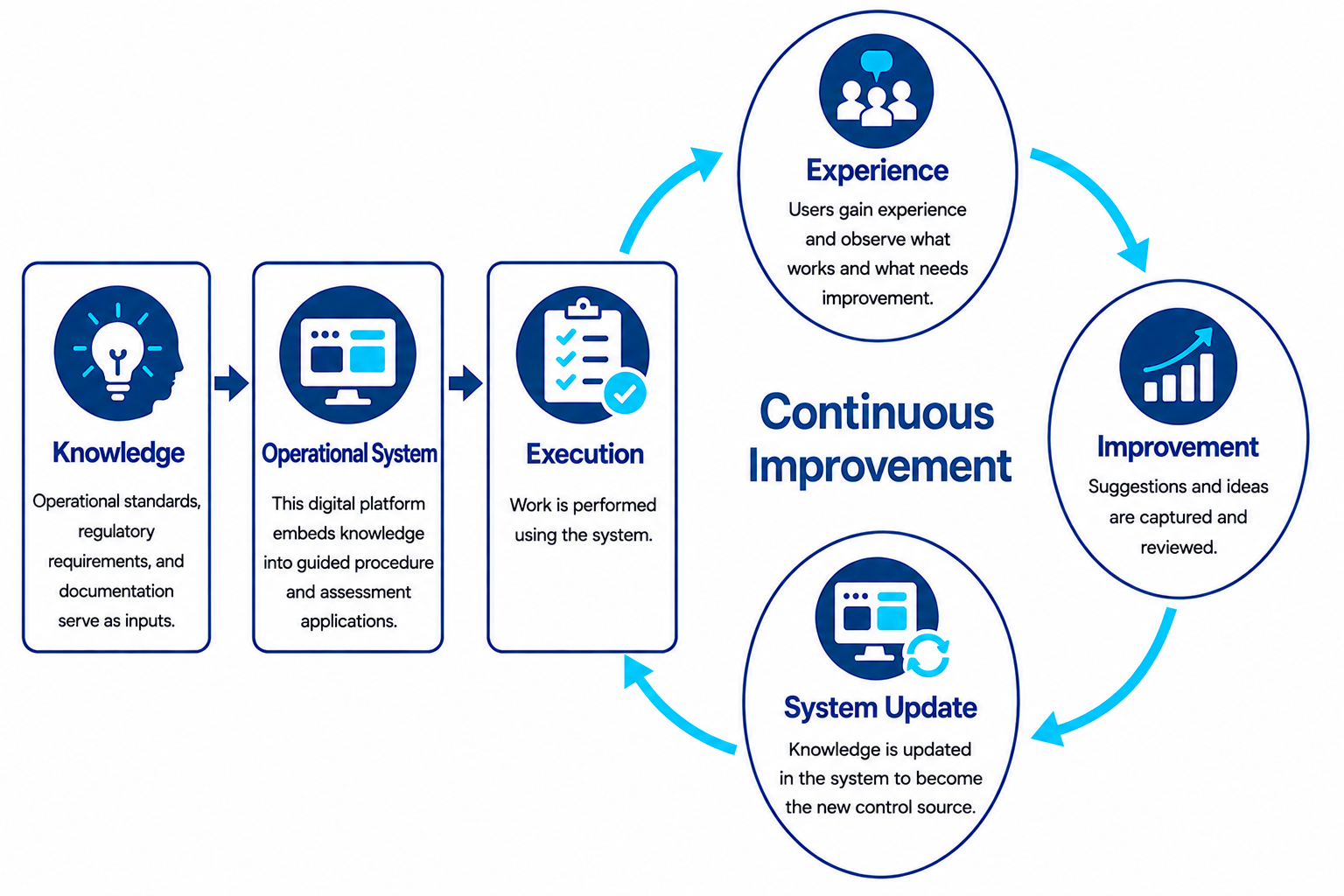
An operational system not only guides work, it turns every execution into an opportunity to improve organizational knowledge.
Instead of treating a digital procedure or assessment as something that is created and occasionally updated, every use becomes an opportunity to validate and improve the organization's knowledge.
Management still controls the process. Suggestions are reviewed before controlled content is changed. Requirements still have to be met. Subject matter experts remain responsible for determining whether an improvement is technically sound.
But the people closest to the work have a direct path for contributing what they learn.
This becomes particularly important when experienced employees retire, change jobs, or simply move to another responsibility. Their knowledge does not have to leave with them if the organization has made capturing and improving that knowledge part of how work gets done.
The objective isn't simply to digitize documents. It is to create an operational system where organizational knowledge is used, proven, improved, and preserved through everyday work.
GapCross makes retaining institutional knowledge practical. Find out how.